
High-Quality Rubber Materials
Choosing the most effective rubber materials for your project can be a difficult process. Not only are there many different rubber materials to choose from, but most of these materials have overlapping features. Therefore, clear answers during the initial design phase are uncommon. However, working with a reputable can simplify the process and eliminate any confusion. Qualiform has the necessary knowledge and experience to analyze your project and offer accurate material recommendations.
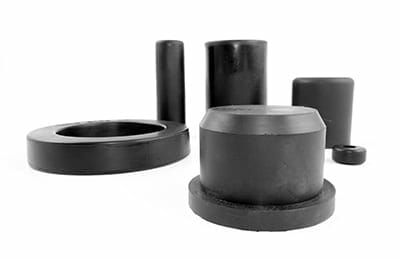
Developing the best custom rubber components for your applications requires using only the finest rubber materials. Qualiform has the ability to process a variety of high-performance polymers depending on your application:
- Butyl Rubber: Lower resilience rubber
- EPDM Rubber: Ideal for outdoor applications
- Natural Rubber: An elastomer with incredible resilience
- Neoprene Rubber: Resistant to oils
- Nitrile Rubber: Exceptional chemical resistance against oils and gasoline
- Rigid & Flexible: Useful for a wide range of applications
- Synthetic Rubber: A versatile elastomer with lower overall cost
- Thermoplastic Elastomers (TPE): High resistance to flame and ozone
- Viton Rubber: Resistance to fuel at at extreme temperatures
How to Choose the Right Rubber Material
Most rubber materials overlap in capability, so the “best” choice depends on your environment and what the part needs to do day after day. Before selecting a compound, it helps to answer a few quick questions:
- Will the part live indoors or outdoors (UV/ozone/weather exposure)?
- Will it contact oil, fuel, solvents, or chemicals?
- What temperature range will it see?
- Does it need to seal (compression set matters) or primarily absorb impact/vibration?
- Is the part exposed to abrasion, tearing, or repeated flexing?
- Do you have a cost target or performance requirement driving the decision?
Rubber Materials at a Glance
| Material | Outdoor / Ozone / UV | Oil / Fuel Resistance | Temperature Handling (General) | Common Fit For |
|---|---|---|---|---|
| EPDM | Excellent | Poor–Fair | Excellent (weather/temp swings) | Outdoor seals, water exposure, weather resistance |
| Nitrile (Buna-N) | Fair | Good–Excellent | Good | Oil & fuel contact parts, shop/industrial environments |
| Neoprene | Good | Good | Good | Balanced all-around performance; weather + moderate oils |
| Natural Rubber | Fair | Poor | Fair | High resilience, impact, and abrasion in controlled environments |
| Butyl | Good | Fair | Good | Air/gas sealing, low permeability applications |
| Viton® / FKM | Good–Excellent | Excellent | Excellent (high heat) | High-heat + chemical/oil environments |
| TPE | Varies | Varies | Varies | When thermoplastic processing benefits the application |