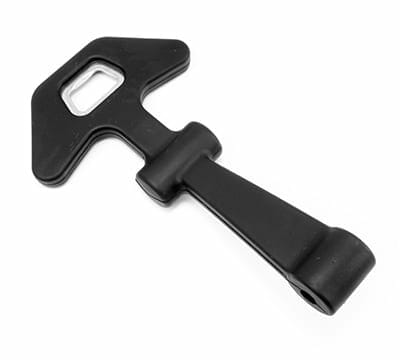
Latches | Transfer Molding
Latches made from transfer molding
- Industry: Material Handling Rubber
- Application:
- Process: Transfer Molded
- Material: EPDM
Transfer Molding
Transfer molding is an ideal process to not only produce precision molded rubber products like latches, but also products that require rubber bonded to metal surfaces. Rubber Transfer Molding combines the advantages of injection molding with the ease of compression molding. Rubber transfer molding is the ideal process for forming parts that require exact positioning, like latches.
Advantages of the Rubber Transfer Molding Process
Transfer molding offers several advantages over other methods by providing:
- Shorter production cycles
- Maintains closer dimensional tolerances than compression molding
- Provides uniformity
- Fast mold setup
- Economical process with high cavity count per mold per cycle
- Cost-effective tooling
- Allows for rubber-to-metal bonding
- Allows for rubber overmolding
- Allows for design flexibility, sharp edges, and intricate parts
The Rubber Transfer Molding Process
The process of transfer molding involves pushing unvulcanized rubber through sprues into a heated mold. Similar to compression molding, transfer molding requires raw material preparation into pellets and/or pre-forms.
Rather than placing the preform in the mold cavity, the rubber preform is placed in a chamber “pot” at the top of the mold, then placed in a press. In the pot, the material is compressed by a heated plunger and transferred through sprues into the cavity below. The plunger is kept in place until the preform takes on the shape of the mold and the rubber is vulcanized. The part cures, hardens, cools, and then is ejected. Excess cured rubber left in the pot is removed, mold cavities are cleaned, and the next molding cycle begins.