
When engineers, product managers, and procurement teams choose materials for custom molded rubber parts, service life is a major concern. Failed seals, gaskets, and isolators can lead to downtime, higher maintenance costs, and safety issues. EPDM is often selected because it offers excellent durability in demanding environments.
Understanding the Basics: How Long Does EPDM Last?
To answer the question of how long EPDM lasts, we must first look at the inherent chemical structure of the material. EPDM is a synthetic rubber known for its saturated polymer backbone. Because it lacks the double bonds found in other rubbers (like natural rubber or standard Neoprene), it is far less susceptible to degradation from environmental attacks.
Under normal, optimal conditions, the average EPDM rubber lifespan can range anywhere from 20 to 50 years.
However, this impressive timeline is highly dependent on the specific application, the environmental stressors it faces, and the quality of the compounding and molding process.
- Outdoor/Weather Applications: 30 to 50 years.
- Automotive Under-the-Hood: 10 to 15 years (due to higher heat and localized fluid exposure).
- Water & HVAC Systems: 20 to 30+ years.
Key Factors Affecting EPDM Longevity
EPDM Weather Resistance: Why It Outperforms the Rest
EPDM is widely used in outdoor applications because of its strong resistance to weathering.
- Ozone Resistance: Ozone attacks the double bonds in many types of rubber, leading to surface cracking (commonly known as “dry rot”). Because of EPDM’s saturated main chain, it is essentially immune to ozone degradation.
- UV Stability: Prolonged exposure to direct sunlight and ultraviolet radiation breaks down lesser elastomers rapidly. EPDM easily repels UV rays, maintaining its physical properties and structural integrity without the need for heavy protective coatings.
- Water and Steam: EPDM is hydrophobic. It does not absorb water and will not swell or degrade even in continuous submersion. Furthermore, its resistance to high-temperature steam makes it a staple in geothermal and boiler applications.
Best Practices for EPDM Maintenance and Care
Even with a material as durable as EPDM, proper installation and ongoing care can extend its functional life. Implementing a few common-sense EPDM maintenance protocols ensures you get the maximum ROI from your molded components.
- Avoid Petroleum Contamination: Keep petroleum-based lubricants, oils, and greases far away from EPDM parts. If a lubricant is needed during installation, strictly use silicone-based or water-based lubricants.
- Proper Compression Ratios: For gaskets and O-rings, over-compressing the EPDM during installation can damage the polymer matrix and lead to compression set failure. Always adhere to engineered torque specs and compression limits.
- Routine Visual Inspections: For critical systems, perform routine checks for signs of hardening, chalking, or loss of elasticity. Even though EPDM resists ozone cracking, extreme environmental abuse can still cause mechanical wear over decades.
Why Choose Custom EPDM Molding for Your Next Project?
Getting the maximum lifespan out of your EPDM components doesn’t just come down to the material. It comes down to the manufacturer. High-quality custom EPDM molding ensures that the compound is perfectly mixed for your specific application and cured flawlessly to prevent defects.
At Qualiform Rubber Molding, we specialize in manufacturing premium EPDM parts tailored to your exact specifications. Depending on the volume, geometry, and tolerance requirements of your part, we utilize industry-leading techniques, including
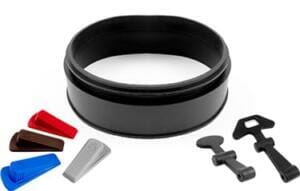
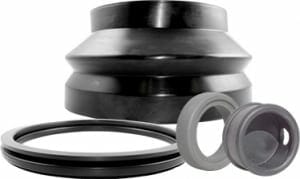
Compression Molding: The cost-effective choice for larger, bulkier EPDM components like heavy-duty vibration isolators or thick seals.
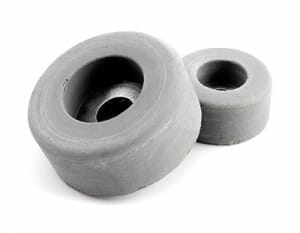
Transfer Molding: Perfect for intricate parts that require precise dimensional tolerances or over-molding EPDM onto metal substrates.
Partner with Qualiform Rubber Molding Today
Don’t leave the success of your custom rubber parts to chance. Partner with an experienced, USA-based manufacturer who understands the nuances of polymer science and custom molding.
Ready to get started on your custom EPDM molding project? Contact Qualiform Rubber Molding today to request a quote or speak with our experts about your needs.